
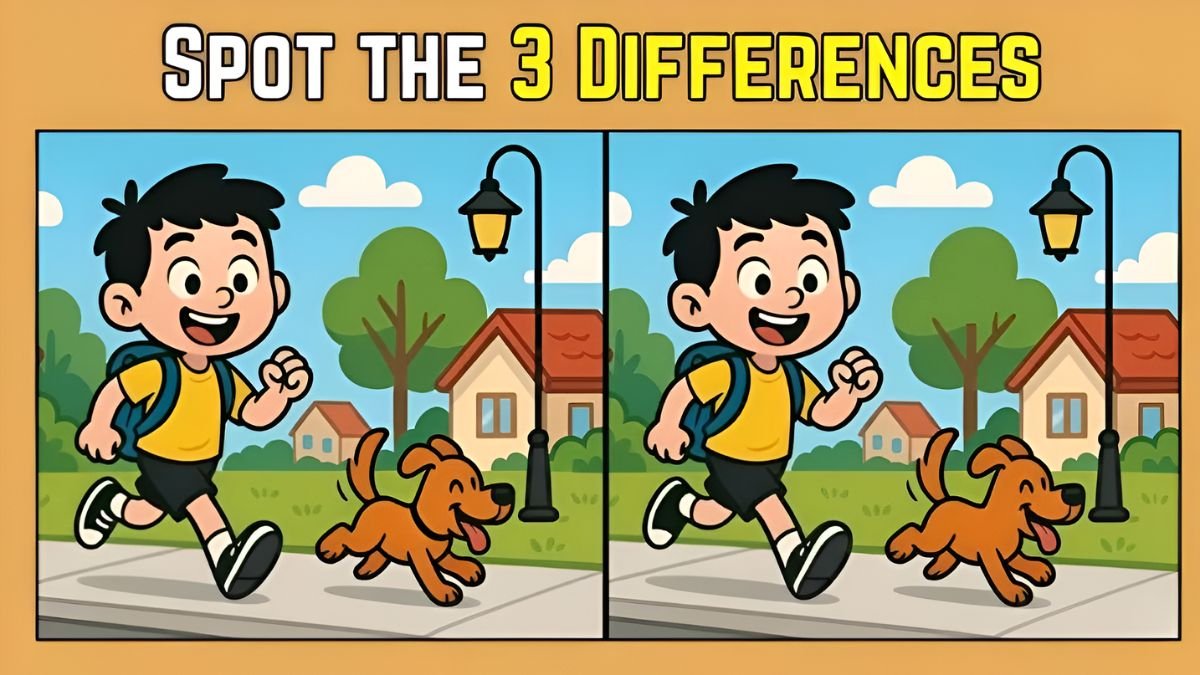
In today’s digital world, our attention is often divided between mobile screens, social media, and notifications. In such a scenario, a small visual challenge not only grabs our attention but also activates our minds. The “Spot the Difference” puzzle is one such game that, while seemingly simple, is actually quite challenging for the brain. In this particular schoolboy puzzle, you are given two almost identical pictures and have to find three subtle differences between them in just 8 seconds. This short time limit makes it even more exciting.
What are Spot the Difference Puzzles?
Spot the Difference puzzles are visual games that present two pictures that look identical at first glance. However, upon closer inspection, subtle differences become apparent. These differences might be in a color, a piece of clothing or shoes, or a small detail in the background. The real fun of these puzzles lies in finding these hidden differences, which test both your eyes and your brain.
Why are these puzzles important for the brain?
These visual puzzles are not just for passing the time; they are also a great way to keep the brain healthy and active. When you compare two pictures, your brain works to recognize patterns, pay attention to small details, and make quick decisions. This improves your concentration, strengthens your memory, and sharpens your visual perception. For children, they make learning fun, and for adults, they help maintain mental agility.
The 8-Second Schoolboy Challenge
In this particular challenge, you are given two pictures of a schoolboy. At first glance, both pictures look exactly the same, but in reality, there are three subtle differences hidden within them. You have to identify all three differences within just 8 seconds. During this time, you need to pay close attention to the boy’s clothes, shoes, face, the dog standing next to him, and the surrounding environment. Due to the time limit, both your eyes and brain have to work quickly.
Where can the differences be hidden?
In a spot the difference puzzle, the differences can be hidden anywhere. Sometimes there’s a slight change in the boy’s uniform, sometimes in the design of his shoes, and sometimes in the animal standing nearby or the trees in the background. Often, these differences are so small that they are not visible at first glance. Therefore, it’s important to slowly scan the picture from top to bottom and left to right, paying attention to every small detail.
Solution: The three differences in this puzzle
If you couldn’t find all three differences within the time limit, there’s no need to worry. With practice, your observation skills will improve. The three differences in this puzzle are as follows: The first difference was in the boy’s shoes, where a small part of the sole was missing in the second picture. The second difference was related to the tree in the background, where one of its branches was missing in the second picture. The third difference was related to the dog, which had a collar in the first picture, but it was not visible in the second.
What are the benefits of doing such puzzles daily?
If you do such puzzles regularly, your brain gradually becomes faster and more alert. Your visual memory improves, you start noticing small details quickly, and your concentration increases. This habit is also useful in everyday life, whether it’s focusing on studies, finding errors at work, or solving a problem.
Conclusion
This 8-second schoolboy spot-the-difference puzzle is not just a fun game but also a great exercise for both your brain and eyes. Whether you found all three differences on time or not, what’s more important is that you challenged your mind and tried something new. Such puzzles not only entertain but also improve mental health and concentration. The next time you encounter such a challenge, be sure to try to solve it with full concentration.
FAQs
Q. What is this Spot the Difference challenge?
A. It is a puzzle where you find three small differences between two schoolboy images.
Q. How much time is given to solve it?
A. You have only 8 seconds to find all three differences.
Q. How many differences are hidden?
A. There are three hidden differences in the images.
Q. What skills does this puzzle improve?
A. It improves focus, observation, and visual memory.
Q. Are these puzzles good for the brain?
A. Yes, they help keep the mind sharp and active.