
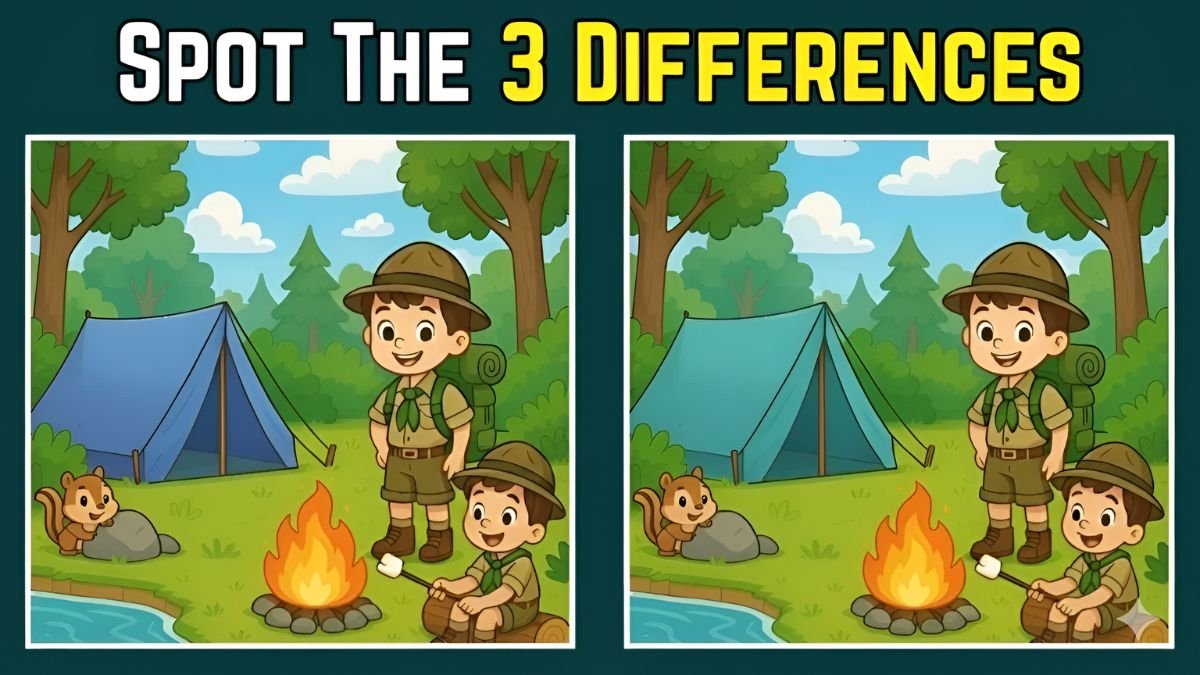
Spot 3 Differences in the Camping Picture: If you enjoy games that are both fun and mentally stimulating, this camping-themed “Spot the Difference” challenge is perfect for you. At first glance, the two pictures look so similar that people think, “How hard can this be?” But that’s the biggest trap of this puzzle. The tranquil forest, the children’s tents, the lush greenery of the trees, the blue sky, and the scattered clouds… everything is so similar that the mind automatically assumes the two pictures are identical.
The real challenge begins when you start looking closely. There are three very small but cleverly hidden differences between these two beautiful camping scenes. And the 12-second time limit adds even more pressure. Your eyes have to scan every corner very quickly, and your brain has to compare and spot the differences instantly.
Why this puzzle is so effective for the brain
Puzzles like Spot the Difference are not just games; they are excellent training sessions for the brain. When you look at two almost identical pictures, your brain first recognizes the larger patterns and similarities. It assumes everything is the same, so it tends to overlook the smaller details.
But this very habit works against you in this puzzle. As soon as you consciously start paying attention to the small details, your brain snaps out of its “auto mode” and becomes fully alert. This strengthens your focus, visual memory, and attention to detail.
The 12-second time limit makes the process even more interesting. Now you don’t have much time to think. You have to look, compare, and decide quickly. That’s why this puzzle is not only fun but also very beneficial mentally.
What’s in the picture?
These two pictures depict a beautiful camping scene. Tents are pitched in the middle of the forest, children are standing outside, trees are spread all around, and the open sky is visible above. The entire scene looks so peaceful and balanced that the mind perceives it as a single image.
But upon closer inspection, you’ll realize that some things are slightly different. Something new has been added, something is missing, and a small change has been made somewhere. These are the three differences you need to find.
Now it’s your turn: Can you find all three differences in 12 seconds?
Challenge yourself. Look carefully at both pictures. Try not to linger in one place for too long. Move your eyes from top to bottom and left to right. Pay attention to the children, the trees, the sky, and the small objects.
If you want, you can set a 12-second timer on your phone for added fun. Play it as a little game with friends or family and see who has the sharpest eyes.
Solution: Here are the three cleverly hidden differences.
If you couldn’t find all three differences in time, don’t worry. These differences are indeed very cleverly hidden.
First difference: The owl on the tree
In the picture on the right, an owl is peacefully sitting on a tree branch. But in the picture on the left, the same branch is completely empty. Since it’s in the upper part of the tree, most people don’t notice it quickly.
Second difference: The boy’s tie
In the picture on the left, a boy is standing wearing a green tie. This small detail is part of his clothing, so the mind considers it part of the background. But in the picture on the right, the tie is missing.
Third difference: The changing clouds
Both pictures show the sky, but the shape and position of the clouds are different. The cloud formation in the right picture is slightly different from the one on the left. This change is so subtle that it requires very careful observation to spot it.
Why people often miss this challenge
Most people fail to focus correctly in the first few seconds. They try to see the whole picture at once, instead of breaking it down into parts. Additionally, our brains tend to focus on faces and larger objects, while smaller details like a tie, an owl, or clouds are easily overlooked.
Time pressure also contributes to mistakes. As the seconds tick away, the brain becomes flustered, and visual accuracy decreases.
These puzzles can also help in your everyday life.
Playing these kinds of visual puzzles improves your concentration, sharpens your mind, and helps you spot small details more quickly. Whether it’s finding typos while reading, not missing details at the office, or simply being more observant of your surroundings, this practice is beneficial.
In conclusion
This camping-themed “spot the difference” challenge is not just a fun game but a true test of your observation skills and mental acuity. Spotting the subtle differences like the owl, the tie, and the clouds in just 12 seconds isn’t easy, but that’s what makes it so engaging and rewarding.
FAQs
Q. What is this camping picture puzzle?
A. It is a spot-the-difference game where you find three hidden changes between two images.
Q. How much time do you get to solve it?
A. You have only 12 seconds to find all three differences.
Q. How many differences are there?
A. There are three small differences hidden in the two pictures.
Q. What skills does this puzzle test?
A. It tests your focus, observation, and visual attention.
Q. Are these puzzles good for the brain?
A. Yes, they help improve concentration and sharpness of the mind.